
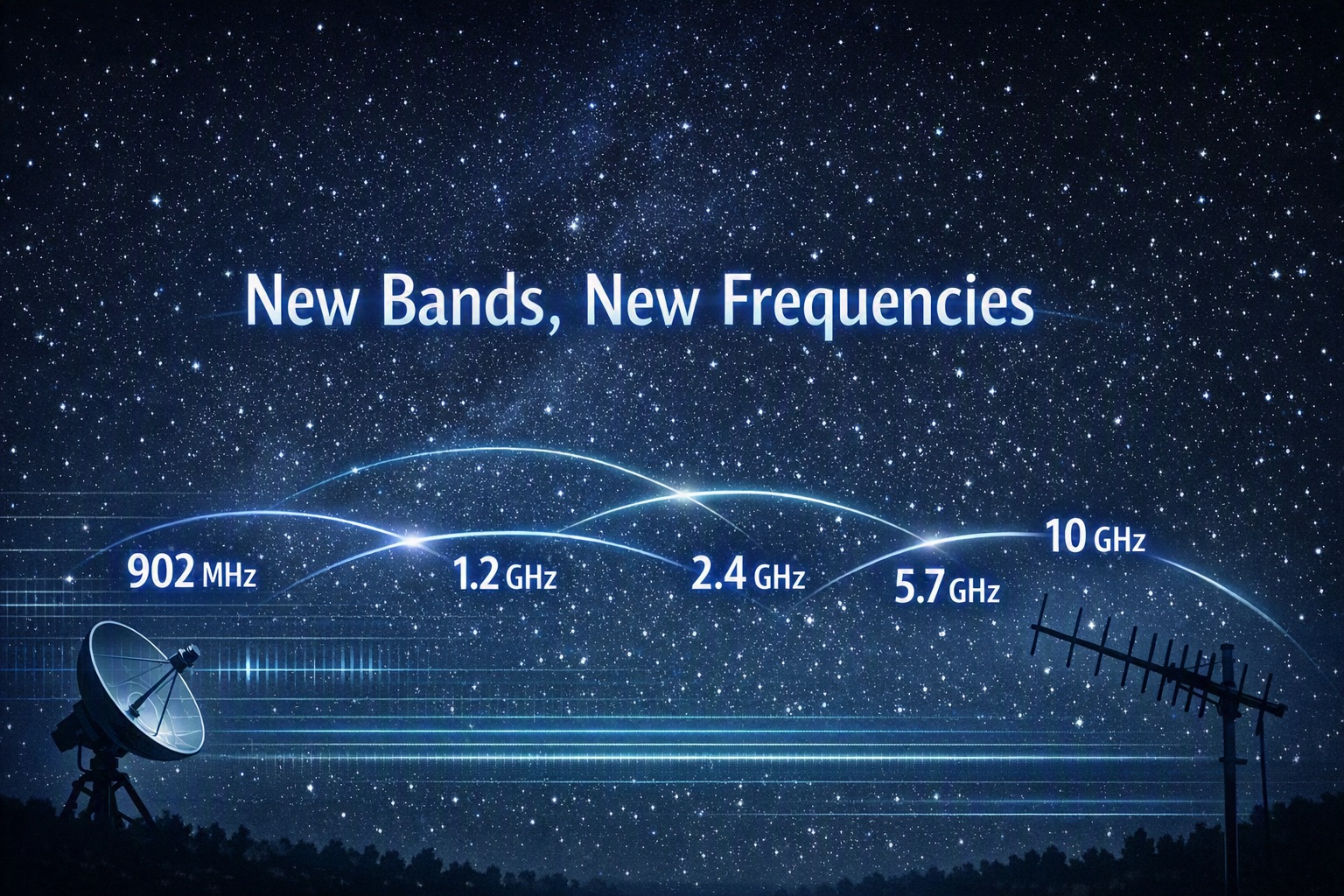
900 MHz and Above
Discovering the Upper Bands
In the last few months, I’ve started to hear and see more about amateur radio activity above the familiar UHF bands. I had read a little about SHF—super high frequency—while preparing for the Extra exam, but I mostly thought of those bands as satellite territory. Once I started looking into satellites a little more, though, I began to notice something surprising: the frequencies from around 900 MHz up through 10 GHz seem to be seeing a real resurgence.
A Little Radio History
That surprised me because I had always pictured most of ham radio history as living down in the HF bands, especially 10 meters and below. And to be fair, there is a lot of history there. I know there was a time when many fire and police departments used frequencies around the 10-meter range. I like old radio programs, and every now and then I hear episodes of The Texas Rangers. At first, I thought the idea of communicating from one ranch to another across Texas in the late 1940s or early 1950s had to be a bit of fiction. But the more I learned, the more I realized they may have been using early mobile 10-meter radios. I have experienced a little of that myself, with 10-meter contacts reaching across the state of Kansas.
Public Service Radio Moves Up the Spectrum
Over time, public service radio moved higher and higher in the spectrum. My first scanner, an out-of-date Uniden, will tune up to about 580 MHz, which I suspect reflects a time when those frequencies were used more widely by police and fire departments. By the 1980s, many of those agencies had moved into the 800 MHz range, and many have since moved to digital systems. In Kansas, much of the law enforcement and emergency medical radio traffic now lives around 800 MHz and uses P25 digital voice.
Commercial Gear Finds a Second Life
That shift has had an interesting side effect for hams. There are now a lot of used commercial radios on the market—especially Kenwood and Motorola radios—that operate in the 800 MHz and 900 MHz range. I have also heard that a few Icom commercial radios can be useful in this part of the spectrum. At the same time, general-purpose radio gear has continued to cover wider frequency ranges, satellite equipment has become more affordable, and ham satellites have become more common. All of that seems to be creating a kind of convergence in the upper UHF and lower microwave bands.
What I’m Seeing Now
I am starting to see more and more examples of this online. A few days ago, I watched a good YouTube video about 900 MHz and the growth of repeaters on that band. I also saw a post about 10 GHz phone communications, which is the kind of thing that still feels a little exotic to me. I have been working my way through Data Networks for Ham Radio, published by the ARRL, and I have a friend who has started building an AREDN network on the 5 GHz band. My nephew, who is not a ham yet, has also been experimenting with Meshtastic, which I think he is using around 900 MHz.
Back to the Farm
All of this has gotten me thinking again about one of my favorite themes: complicated ways to talk to my wife. She has managed to put off getting her amateur radio license for the last few years, so when I talk to her by radio I still have to use FRS, GMRS, CB, or business-band radios. Now I am starting to wonder whether the ISM frequencies above 800 MHz might eventually give me one more option. I have been waiting for one of the LoRa development lines to produce a practical way to do digital voice on one of those frequencies. We will see whether I can add yet another layer of complication to the simple goal of talking across the farm.
For now, that is what makes the 900 MHz band and the other bands above 23 centimeters so interesting to me. They sit at the crossroads of old public-service equipment, newer digital networks, satellites, experimentation, and plain old curiosity. I am still learning what is possible up there, but it feels like a part of amateur radio where practical communication, tinkering, and discovery all meet. That is usually enough to get me interested—and maybe enough to get one more radio into service around the farm.